Facial Recognition Algorithms Explained: How They Work
Facial recognition algorithms are software methods that identify or verify a person by analyzing their face in an image or video. They work by detecting a face, measuring key facial features, and comparing those measurements to faces stored in a database or on a device.
How Facial Recognition Algorithms Work
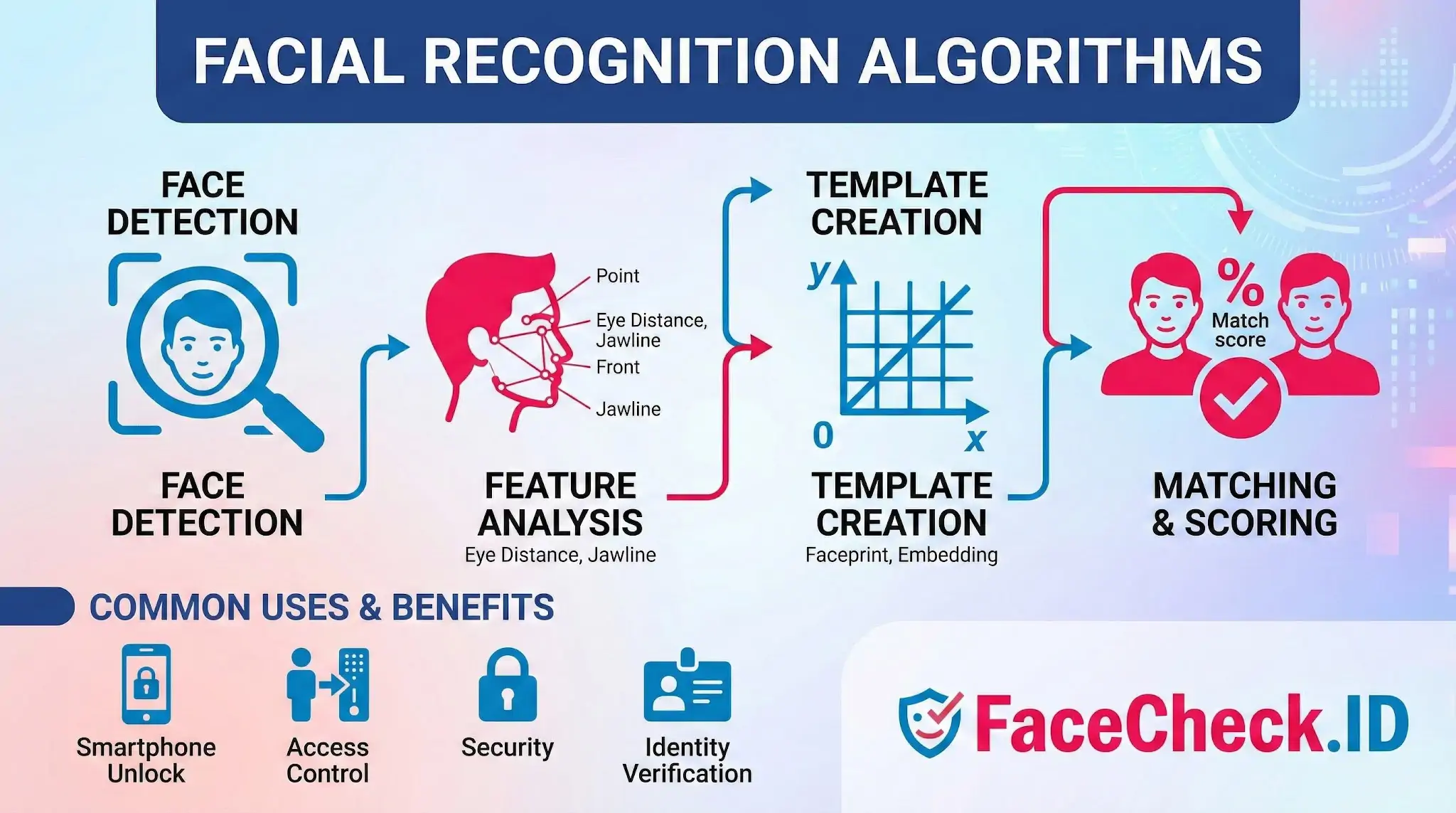
Most facial recognition systems follow a similar process:
- Face detection
Finds a face within a photo or video frame.
- Feature analysis
Measures distinctive facial landmarks such as the distance between the eyes, the shape of the jawline, and the contours of the nose and cheeks.
- Face template creation
Converts facial measurements into a mathematical representation, often called a faceprint or embedding.
- Matching and scoring
Compares the template to known templates and returns a match score to confirm identity or suggest possible matches.
Common Uses
Facial recognition algorithms are used across many consumer and enterprise applications, including:
- Smartphone unlocking and device authentication
- Access control for buildings, workplaces, and events
- Security and surveillance systems
- Social media photo tagging and face grouping in photo libraries
- Identity verification in banking and online services
- Reverse image search to find similar faces or potential matches across the web
Key Benefits
- Fast identity checks without passwords
- Convenient user experiences on personal devices
- Scalable matching for large image collections and databases
Important Considerations
Performance can vary based on lighting, camera quality, angles, and image resolution. Privacy, consent, and data security are also major factors when facial recognition is used in public or sensitive settings.
FAQ
What are “Facial Recognition Algorithms” in a face recognition search engine?
Facial recognition algorithms are the mathematical and machine-learning methods that detect a face in an image, normalize it (e.g., alignment), and convert it into a numeric representation (an embedding) that can be compared against an indexed database to retrieve likely matches on the web.
What are the main stages of a facial recognition algorithm used for face search?
Most face-search systems follow a pipeline: (1) face detection (find the face region), (2) landmarking and alignment (standardize pose/scale), (3) feature extraction (generate an embedding/faceprint), (4) similarity search (nearest-neighbor lookup in an index), and (5) ranking and filtering (remove low-quality or duplicate results and order candidates by score).
What types of models power modern facial recognition algorithms (e.g., CNNs vs. transformers)?
Modern facial recognition commonly uses deep neural networks trained to produce embeddings where the same person clusters together. Many systems are based on convolutional neural networks (CNNs), while newer approaches may use vision transformers or hybrid architectures. In practice, the model choice affects robustness to lighting, pose, blur, and cross-site image variation, which can change the quality of matches returned by face recognition search engines.
Why can different face recognition search engines return different results for the same photo?
Results can differ because engines may use different facial recognition algorithms, training data, face-alignment methods, similarity thresholds, and indexing strategies, and they may crawl different parts of the web. Even with the same algorithm, update cycles and ranking rules can change which matches appear first. For example, tools like FaceCheck.ID may prioritize certain source types or apply specific filtering that influences which candidates you see.
What are common failure modes of facial recognition algorithms in face search (and how can I reduce them)?
Common failure modes include poor image quality (blur, low resolution), extreme angles, heavy occlusion (masks, hair, hands), harsh lighting, strong edits/filters, and look-alike faces that produce similar embeddings. To reduce errors, use a sharp, front-facing image with good lighting, minimal filters, and a clearly visible face; try multiple photos from different angles; and treat results as leads that require verification via context (source page, dates, additional photos), including when reviewing matches on FaceCheck.ID or similar services.


Recommended Posts Related to facial recognition algorithms
-
Examining the State-of-the-Art in Facial Recognition Algorithms for Unconstrained Environments
Top Facial Recognition Algorithms 2023 Reviewed and Compared. In this context, there is a growing interest in understanding the technical details and performance of different facial recognition algorithms, as well as their ethical, legal, and social implications. DeepFace is a facial recognition algorithm developed by Facebook, which uses a deep neural network with 3 billion parameters to perform face verification and recognition.
-
How to Reverse Image Search Mugshots
It uses powerful facial recognition algorithms to match uploaded images with mugshots in the database, providing users with accurate and fast results. - **False positives:** Facial recognition algorithms may occasionally produce false positives, leading to misidentification. Biases in algorithms: Biases in the data used to train facial recognition algorithms may result in unfair treatment of certain groups, leading to potential ethical concerns.
-
How to Use Reverse Image Search to Find LinkedIn Profiles by a Photo
Facial recognition algorithms analyze the unique features of a person's face, including the shape of the eyes, nose, mouth, and jawline, to create a digital image of their face. FaceCheck.ID uses advanced facial recognition algorithms to match the photo of the individual in a photograph and find a corresponding LinkedIn profile.
-
How-To Guide for Effective Face Lookup
Robust facial recognition algorithms. Face Lookup Technical Foundations: Unveiling the Power of Facial Recognition Algorithms. Face lookup technology is fundamentally based on sophisticated facial recognition algorithms that utilize deep learning techniques to identify and analyze unique facial features in images.
-
Top 5 Reverse Image Search APIs for Your Projects
Cutting edge facial recognition algorithm and fast search.
-
Google's Image Search vs. Yandex's Image Search: A Detailed Look
How Facial Recognition Algorithms Identify Faces.
-
Search for Actors by their Face
Explanation of the facial recognition technology used: FaceCheck.ID uses advanced facial recognition algorithms that analyze and compare facial features to a vast database of actors, ensuring accurate results.
-
How to Find Someone by Doing Reverse Face Search
Yandex reverse face search features a good face recognition algorithm that can match faces in photographs.
-
Leveraging Facial Recognition Technology to Combat Human Trafficking
FaceCheck.ID's facial recognition algorithms scan and compare facial features against extensive collections of social media profiles, escort workers, and wanted criminals, helping to match images of potential victims with those of missing persons.
-
Facial Recognition: Understanding the Basics
These metrics are critical in evaluating the reliability of facial recognition algorithms.
-
Top 6 Reverse Image Search Mobile Sites to Find People, Products, and Places
FaceCheck.ID uses advanced facial recognition algorithms, ensuring that the matches you receive are relevant and precise.
-
How to Find Someone with a Photo?
However, its facial recognition algorithm still needs some work.